
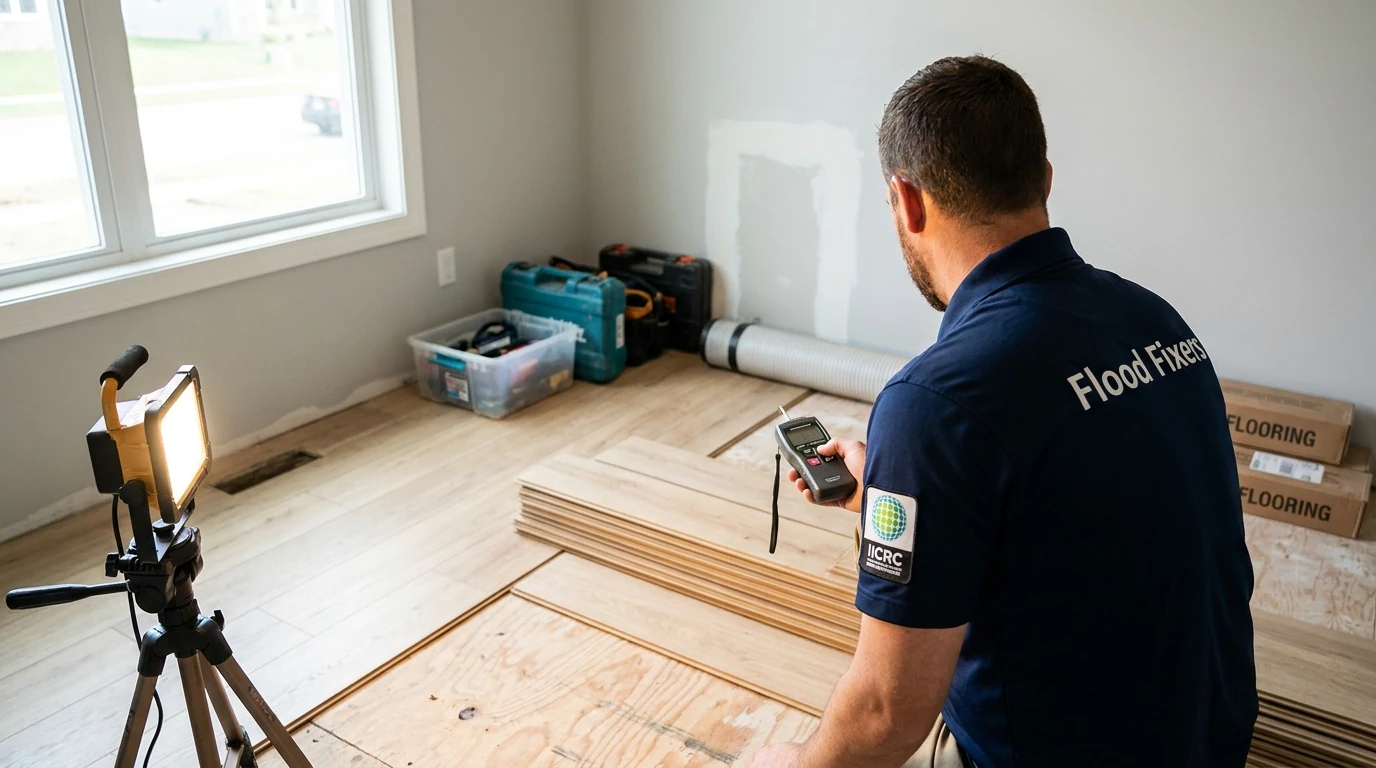
TL;DR: A water damage job “going right” means the drying phase finishes before anyone touches flooring, the schedule holds, and the crew does a final quality check after the new flooring is in, not just after the demo. That sequence, dry first, rebuild second, verify last, is what separates a restoration job that lasts from one that gets redone in a year.
When a pipe fails or a water heater floods a room, most homeowners assume the hard part is getting the water out. It isn’t. The hard part is making sure the subfloor and framing are fully dry before new flooring goes down, and then confirming the finished work actually holds up. A recent five-star review left for Flood Fixers captures exactly that process, start to finish.
i’d like to leave a review based upon the exceptional work done in my home. Their services were completed on time, quality assurance after flooring was completed. Thank you
Erik, verified Google review
What does “completed on time” actually mean on a water damage job?
On a job with structural drying and flooring replacement, “on time” means the crew held to the schedule they set after the initial moisture readings, not an arbitrary move-in date. A realistic timeline gets built once the extent of the water intrusion is known, and it accounts for drying time before any flooring or finish work starts.
Most residential water losses need three to five days of active structural drying with air movers and dehumidifiers running continuously, based on the ANSI/IICRC S500 Standard for Professional Water Damage Restoration. That number moves depending on how much water got in, what materials absorbed it, and how enclosed the space is. A schedule that holds is a sign the crew measured correctly on day one instead of guessing.
What throws a timeline off is almost always skipped drying, not slow contractors. A crew that commits to a date and keeps it usually did the moisture mapping right from the start.
Why does flooring replacement come after drying, not before?
Flooring goes down last because installing it over a subfloor that still reads wet traps moisture under the new material, which is exactly the condition mold needs to start growing within 24 to 48 hours, per EPA guidance on mold and moisture. New flooring is also the most visible, most expensive part of the rebuild, so it’s the last thing anyone wants to redo.
The sequence on a sound job looks like this:
- Water extraction and initial moisture readings on the subfloor, framing, and any affected drywall.
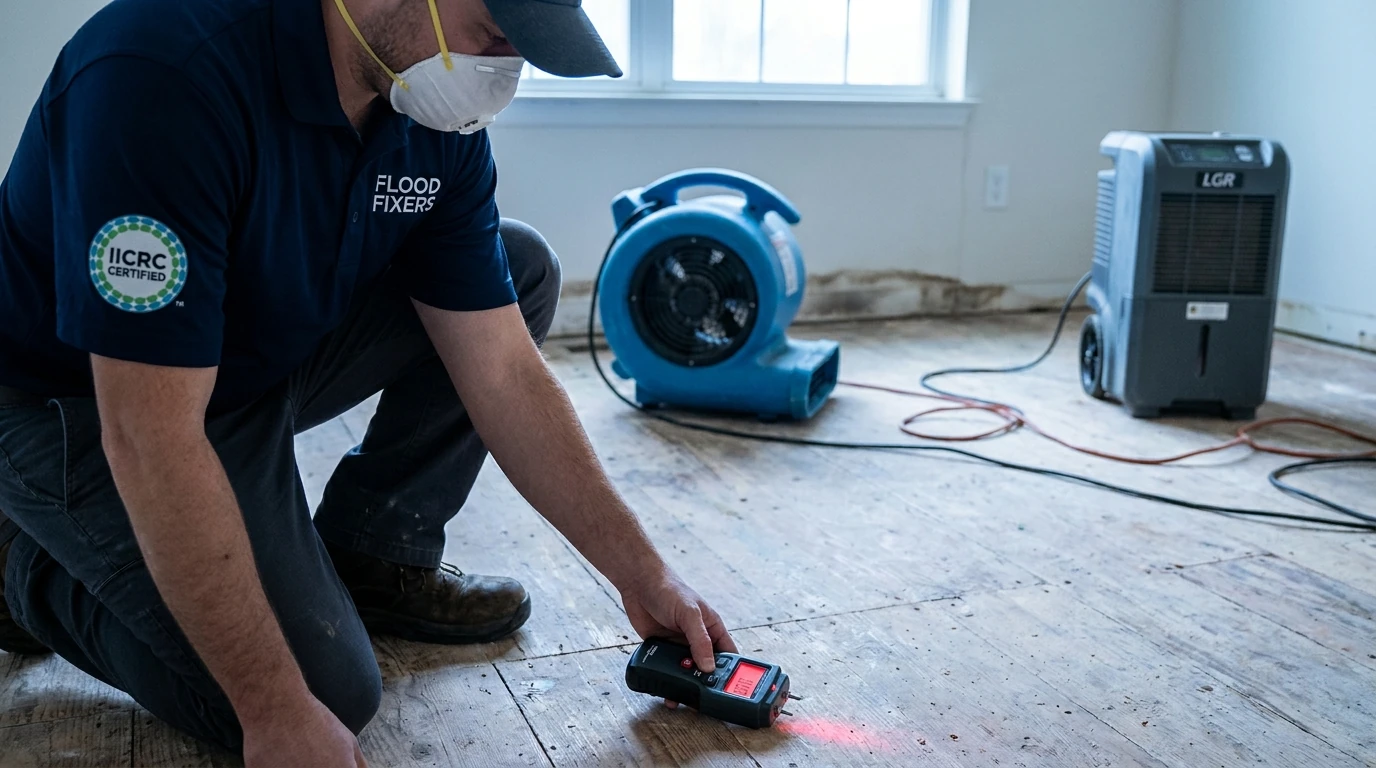
- Structural drying with air movers and dehumidifiers, with daily moisture monitoring until readings return to a dry standard.
- Repairs to subfloor, framing, or drywall as needed before any finish materials go back in.
- Flooring installation once the structure tests dry.
- A final walkthrough and quality check after the flooring is down.
Skip step 2 or shorten it to hit a deadline, and the flooring installed in step 4 is sitting on a problem that hasn’t actually been solved. Our guide to the full restoration process walks through each phase in more detail, and how long restoration actually takes covers realistic timelines by damage type.
What does “quality assurance after flooring was completed” look like in practice?
A real quality check after flooring installation means someone walks the finished space, checks for gaps, unevenness, and transitions, and verifies the subfloor underneath still reads dry, not just that the new material looks good. It happens after the visible work is done, which is the point in the job where it’s easiest to skip.
That final step is where a lot of restoration jobs quietly fall short. Once flooring is in, a crew can walk away and the customer has no easy way to check whether the subfloor underneath is actually dry or whether the seams and transitions were installed correctly. A documented final walkthrough, with a moisture meter check and a visual inspection of the finish work, closes that gap. It’s also the moment where small punch-list items, a transition strip that’s slightly loose, a baseboard that needs a touch-up, get caught before the customer is living on top of them.
What this means if you’re dealing with water damage right now
If you’re looking at water damage and flooring that needs to come out, ask any company you’re considering how they sequence drying and flooring, and whether they do a documented check after the finish work is in. That one question tells you whether you’re dealing with a crew that treats drying as a formality or as the step that protects everything built on top of it.
Flood Fixers is IICRC Certified and EPA Lead-Safe Certified, and offers 24/7 emergency service across San Diego County. Request a water damage assessment or call Flood Fixers at (855) 204-1124 to get a written scope before any flooring or rebuild work starts.