
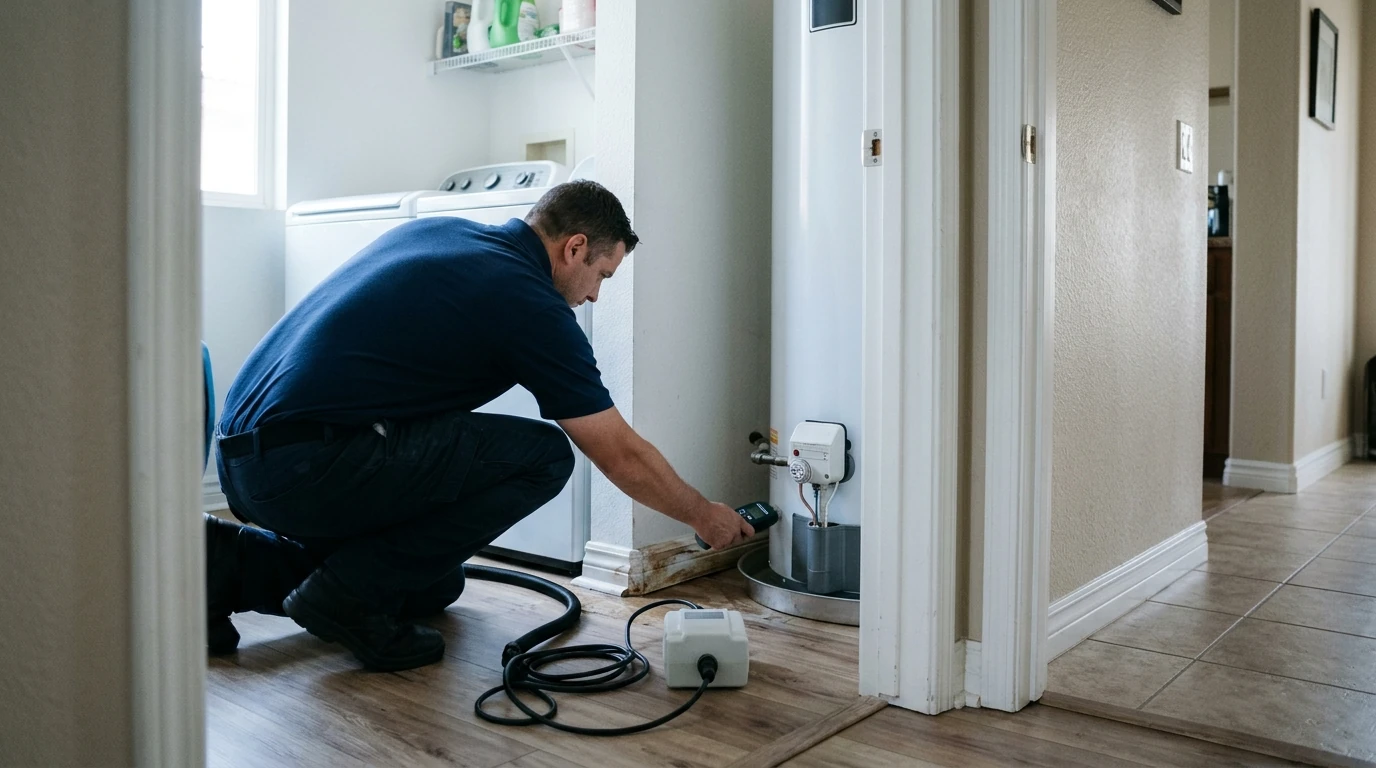
If your water heater is leaking in San Marcos, shut off the cold water supply valve at the top of the tank and cut the gas or breaker to the unit first. Then call a plumber to stop the leak at its source, and call Flood Fixers at (855) 204-1124 if water has already reached drywall, baseboards, flooring, or a garage slab seam. The crew runs 24/7 emergency service and carries IICRC certification for water damage mitigation.
Do I need a plumber or a restoration company first?
Call a plumber first if water is still actively flowing from the tank, the T&P valve, or a supply fitting. Call a restoration company once the leak is stopped and water has already soaked into flooring, cabinetry, or a wall cavity. If you smell gas or see water pooling near an outlet or electrical panel, cut power at the breaker and call the utility or 911 before touching anything else.
A plumber’s job ends once the tank is drained, the fitting is replaced, or a new unit is installed. That’s a repair call, not a drying call. Water that’s already traveled under a closet door or behind a baseboard in an adjacent room needs extraction, air movers, and moisture mapping, the kind of mitigation described in the ANSI/IICRC S500 standard for professional water damage restoration. Waiting on that step because the plumber “already fixed it” is how a two-day drying job turns into a torn-out baseboard and a mold inspection six weeks later.
What should I do in the first 10 minutes?
Shut the water off at the cold supply valve above the tank, kill the gas valve or flip the breaker feeding the unit, and move anything sitting on the wet floor before the water spreads further. Don’t step into standing water anywhere near an outlet, power strip, or breaker panel.
- Close the cold water shutoff valve above the tank (round handle or lever).
- Turn the gas valve to off, or flip the breaker for an electric unit.
- Pull boxes, rugs, or furniture off the wet floor.
- Photograph the puddle, the tank, and any affected baseboards or flooring before you mop or blot anything, for your insurance file.
- Crack a window or run a fan if the space is small and enclosed.
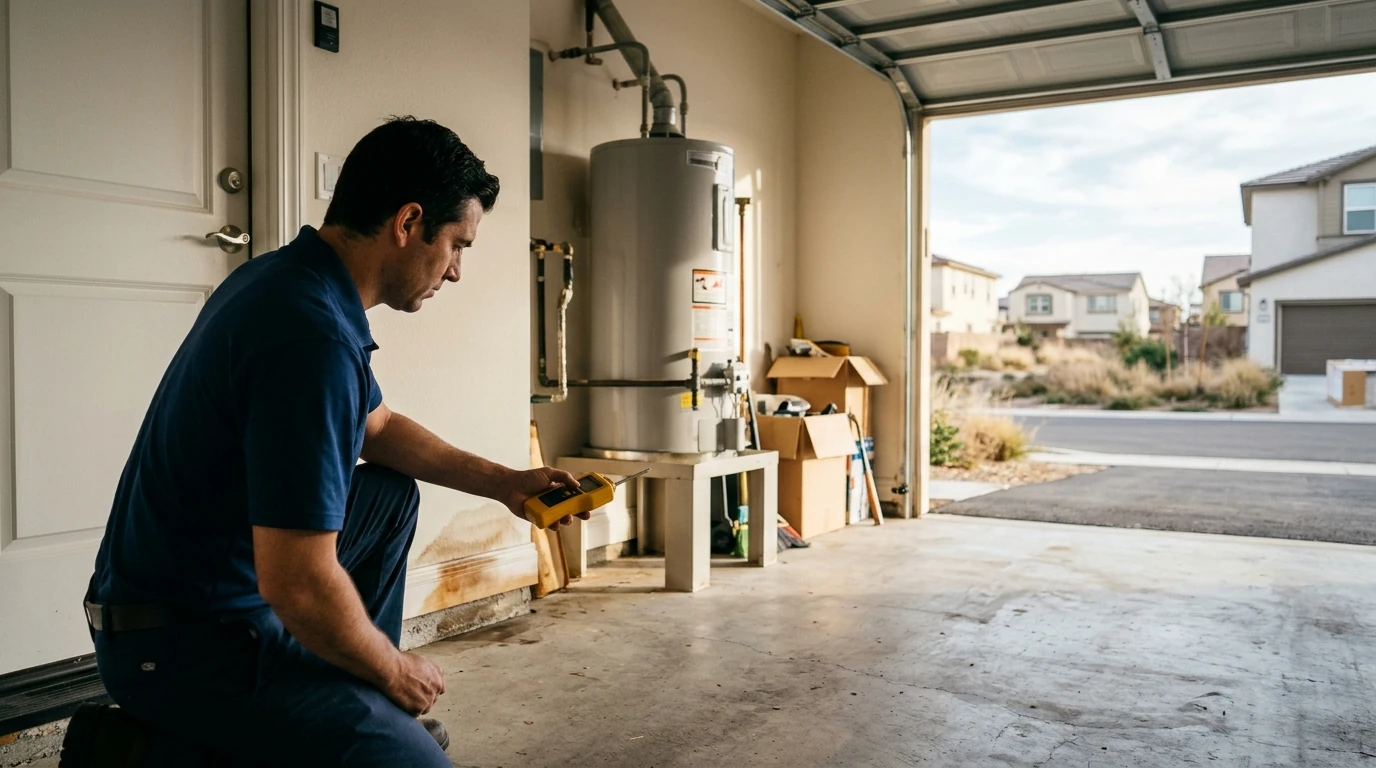
Does it matter if the water heater is in a garage or an interior closet?
Yes. A garage-slab water heater usually leaks onto bare concrete with a floor drain nearby, which limits damage to the slab and maybe a few feet of drywall. A water heater in an interior closet, common in San Marcos homes with the unit tucked near the laundry or a hallway, sits directly over subfloor and often right next to carpet or laminate that wicks water fast.
A lot of San Marcos subdivisions built since the 1990s, including streets near Discovery Lake and San Elijo Hills, put water heaters in interior hallway closets rather than garages. When that closet shares a wall with a bedroom, water can travel under the baseboard before anyone notices. Homes closer to the older grid around Twin Oaks Valley Road more often still have garage units, where the damage usually stays contained near the slab.
What happens when a restoration crew comes out?
A technician checks moisture levels in the drywall, subfloor, and baseboards with a moisture meter, sets up extraction or air movers where needed, and writes a scope of the affected materials your insurance adjuster can use directly.
Have the plumber’s invoice and your photos ready when the crew arrives. In most cases emergency mitigation can start the same day without waiting on insurance approval, as long as the work is documented thoroughly enough to submit afterward. If flooring like laminate or carpet pad has already delaminated or started to smell musty, it typically gets removed rather than dried in place. You can request a water heater flood cleanup assessment the same day the leak is found.
Does insurance cover water heater leak damage?
Most homeowners policies cover water heater leak damage when the failure is sudden and accidental, like a cracked tank seam or a T&P valve that fails without warning. They typically exclude damage from a leak that built up gradually, like a slow drip at the base of the tank that went unnoticed for months.
The Insurance Information Institute outlines this distinction for most standard homeowners policies: sudden failures are generally covered, gradual deterioration and deferred maintenance usually aren’t. Check your own policy’s water damage section before you assume either way, and see our plain-English breakdown of what homeowners insurance covers if you want the fuller picture.
How fast can mold start after a water heater leak?
Mold can begin growing on wet drywall, baseboards, or subfloor within 24 to 48 hours, according to the EPA. In a warm, humid stretch of a San Marcos summer or fall, that window doesn’t get any longer. For the fuller timeline of what happens if wet materials aren’t dried fast enough, see how quickly mold grows after water damage.
Once the plumber has the leak stopped, getting drying started the same day is what keeps a one-closet leak from becoming a subfloor replacement. If you’re not sure whether the water reached framing or just the surface, a water damage restoration assessment can settle it, and anyone dealing with a slow leak they only just noticed may want leak detection service to check the rest of the plumbing run for hidden damage. For the broader decision tree beyond just water heaters, see who to call for water damage in San Marcos and in what order.
About Flood Fixers
The company is a licensed and insured restoration business based in San Diego County, serving San Marcos and the surrounding North County communities. Its crew holds IICRC certification for water damage mitigation and EPA Lead-Safe certification, and runs a 24/7 emergency response line. Technicians document every job with moisture readings and photos homeowners can hand directly to their insurance adjuster.
Need help now? Call Flood Fixers at (855) 204-1124.
Video Transcript
Water heater leaking in San Marcos? Here’s exactly who to call first, and the steps that protect your home and your wallet. A cracked tank seam or failed T&P valve can send water across your floor fast, soaking drywall, baseboards, and subfloor. First things first, shut off the cold water supply valve above the tank, then cut the gas or flip the breaker to the unit. Call a plumber right away to stop the leak at its source, that’s a repair call, not a drying call. Once the leak is stopped, call a restoration company if water already reached your flooring, cabinetry, or a wall cavity. Flood Fixers runs 24/7 emergency service with IICRC-certified technicians trained in professional water damage mitigation standards. Your contractor checks moisture levels in the walls, floors, and baseboards, sets up extraction and air movers, and documents everything for your insurance adjuster. Mold can start growing on wet materials within 24 to 48 hours, especially during a warm San Marcos summer. Most homeowners policies cover sudden tank failures, but damage from a slow, ignored leak usually isn’t covered, so check your policy. Don’t let a small leak turn into a bigger problem. Call Flood Fixers at (855) 204-1124 for a free estimate today.